

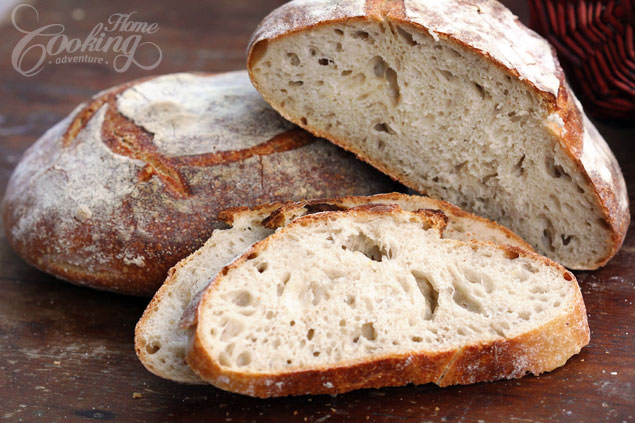
It is very intriguing for me to try making a bread with no yeast, using only water, flour and salt. Therefore I started to make my own starter with only flour and water, I was patient and consequent with the whole process, and after 7 days I was able to bake my first sourdough bread:) I was in heaven.. perfect crispy crust and a soft chewy open crumb.
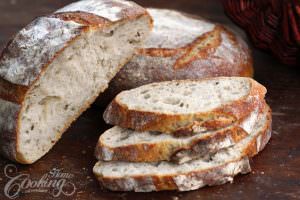
I was afraid it would taste bad, that it would be sour, but on the contrary. This is the best bread I’ve ever baked and eaten so far. It is homemade, no other preservatives involved… it is just perfect. I still can’t say I understand entirely the whole process but I followed some steps and surprisingly… it worked, and it worked just great. My family love it, even my 2 years old daughter who is not passionate about bread likes it very much.
I even started to share from my starter to some family members who are now saying that they won’t bake yeast bread anymore as this one has no comparison. My first sourdough bread is adapted from Vermont Sourdough in Bread: A Baker’s Book of Techniques and Recipes by Jeffrey Hamelman. It is probably one of the easiest recipes using a sourdough starter with amazing results.
RELATED POSTS:
Sourdough Starter from Scratch
50 Percent Whole-Wheat Sourdough Bread
Sourdough Barley Bread
Easy Sourdough Bread - Vermont Bread
Ingredients
Overnight Starter
- 22 g 100% hydration sourdough starter , unfed
- 137 g water at room temperature
- 110 g bread flour
Final Formula
- 600 g bread flour
- 80 g rye flour
- 370 g water at room temperature
- 16g salt
- Overnight Starter which is 125% hydration starter
Instructions
- To make the overnight starter, in the evening stir down the 100% hydration sourdough starter, and remove 22 g in a bowl. First add the water and stir well. Add flour and stir. Cover with plastic wrap, and let it rest at room temperature for 12-14 hrs (overnight). (For the 100% hydration sourdough starter – you either make it to have it your own - as shown here – or take from a friend who has or buy from a specialized store).
- In the morning, in a large bowl mix the flours with water and the overnight starter until well combined. Let the dough rest (autolyse) for 30 minutes.
- Add the salt and knead by hand for 5-8 minutes.
- Wipe the inside of a wide bowl with a little vegetable oil. Place the dough into this wide bowl so the dough can be stretched and folded without removing it from the bowl. Cover with plastic wrap.
- Let the dough ferment at room temperature for 2.5 hours with folds at 50 minutes. The folding is shown here.
- Turn the dough out onto a floured surface. Divide it in two pieces. Shape them in form of a ball. Sprinkle the balls with flour, cover and let rest for 15 minutes.
- Meanwhile prepare two round bowls with 2 kitchen towels, sprinkled with flour. Add the dough balls seam-side-up, cover with the edges of the towel and proof for 2 or 2.5 hours at room temperature. You will know it's done when pressing the dough with the finger the it comes slowly back.
- Preheat the oven to 475 F (240 C) with baking stone or in case you don't have one preheat a baking sheet. Place a small pot with water at the base of the oven to create steam.
- Turn the proofed loaves onto a parchment and score them. You can see some tips here. Carefully transfer it to the preheated baking stone or back of the baking sheet.
- Bake for 15 minutes with steam then remove the pot with water from the oven and bake for another 15- 20 minutes without steam.
- Cool on a wire rack. Let them cool completely before cutting for at least 2 hrs.
Nutrition
Did you make this recipe?
Please let me know how it turned out for you! Leave a comment below and tag @homecookingadventure on Instagram and hashtag it #homecookingadventure.


I adore a good crusty sourdough bread – I miss crusty bread in general, since moving from Germany to the United States. This looks like it fits the bill perfectly 🙂
For sourdough, ask anuord and see if any of your friends have a starter living in their fridge or cupboard. This is a mix of flour, water, natural yeast and bacteria that makes sourdough turn sour and rise.You use some of it to make dough, and feed some more flour and water to the remainder and it re-grows. It’s like having a very boring pet you can eat.Some people call it Amish Friendship Bread instead of sourdough. You can also buy a kit to make the starter on the internet.Once you have a nice living starter, you can check the internet for recipes.The basic recipe for sourdough is to use a regular bread recipe but substitute 1 cup starter for 1/2 cup each of the flour and water, and leave out the yeast. Quadruple the rising time, and make sure it has a nice warm place to rise. Mine rises on top of my stereo amplifier.
Hello. I am new to sourdough bread making..I was wondering if you could tell me what the ” 100% hydration sourdough starter, unfed” means. I have a fresh starter that I just made last Friday from potato water, flour and a smidge of sugar…could I use that in this recipe?
Thank you so much.
doreen
I am new to sourdough bread making too. This is the kind of starter I use. I don't know exactly how you did your starter, if you followed some steps, and fed the starter each day for at least 7 days. If you did than I don't see why it won't work. The fact that you used potato water I don't think it is a problem, don't know about the sugar. I haven't heard till now about a sourdough starter with sugar. What I can tell you is that this starter is working great. Let me know what you have decided and hope you will share with me about your new experience with sourdough bread.
100% hydration refers to the ratio of flour to water, meaning the same weight of flour and water. If it were a 75% hydration starter, you would calculate 75% of the weight of the flour, and add that amount in water.
I baked this recipe today. Fantastic. Very strong dough with explosive oven spring. Thank you!
Yes.. I simply love sourdough bread..I am glad you liked it too. Wish I had more time and make it more often.
This has been my “go to” recipe for about three years now. But I must admit I’ve added a few things. Like some Bob’s 10 grain to the starter, a little oat bran, crushed flax, pumpkin seed, chia seed and (OF COURSE!) sesame. (Each about a quarter cup and an additional 2 TBS of water). That soaks overnight, and the bread is made the following day.
If you already have sourdough starter, how much to add to this recipe when making the bread?
The same amount. This recipe is in case you don’t already have starter.
Why unfed sourdough??